Filter vs Espresso: Why the World's Best Coffee Is Brewed, Not Pulled
Every specialty coffee on earth is scored as filter, never as espresso. A taster of twenty years on why the cup that grades rare coffee is the one that lets you taste it.
Pour a Gesha as espresso and it will taste expensive. Pour the same beans as filter and it will taste like a place: a hillside in Chiriquí, a specific week in March, the jasmine-and-bergamot lift that made a buyer raise a paddle and pay four figures a kilo. Same coffee. Two different truths. And the specialty trade decided, quietly and decades ago, which one counts.
Here is the part almost no café will tell you over the counter. Every coffee you have ever seen called “specialty” — every score printed on a bag, every auction lot, every 90-plus headline — was judged as filter. Never as espresso. The number that decides whether a coffee is special at all was measured with a spoon and a steeping bowl.
So when people ask which is better, filter or espresso, they are asking a question the industry already answered when it decided how to grade coffee in the first place.
The number on the bag is a filter score
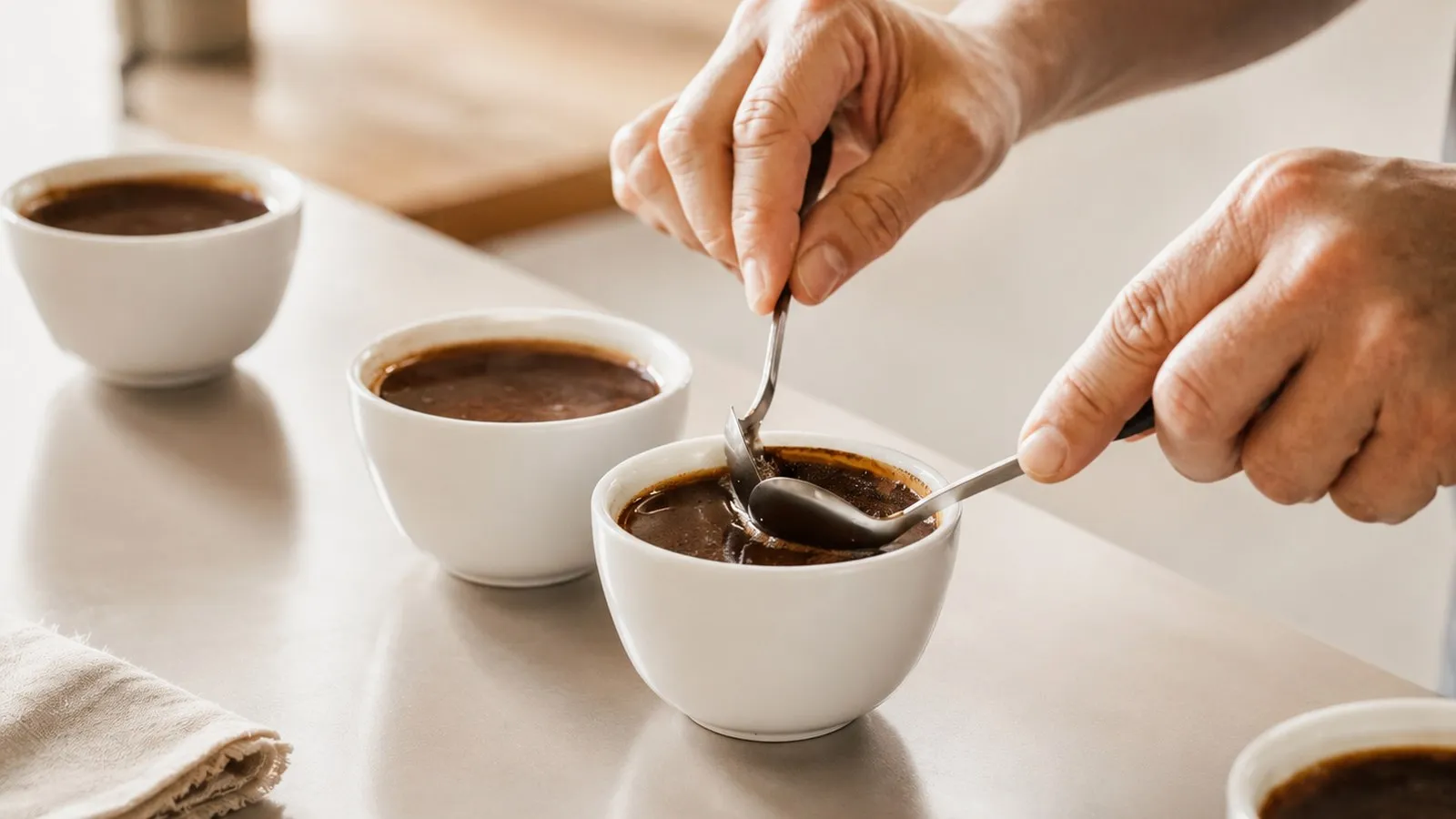
When graders sit down to put a number on a coffee, they don’t pull shots. They cup. The Specialty Coffee Association protocol is almost comically plain: roughly 8.25 grams of coarsely ground coffee to 150 millilitres of water just off the boil, around 93°C, a ratio close to 1:18, left to steep. No pump. No pressure. No nine bars forcing water through a compacted puck in twenty-five seconds. The grounds and the water simply sit together for four minutes.
Then a crust forms on top, the grader breaks it with a spoon, leans in, inhales, and slurps the liquid off the surface loud enough to aerosolise it across the whole palate. Fragrance, flavour, acidity, body, balance, aftertaste, a few others, summed on a scale that runs to 100. Eighty is the line in the sand. Cross it and the coffee is, by definition, specialty. Below it, commodity, no matter what the bag says.
I have sat at hundreds of those tables. The Gesha that broke records at the Best of Panama, the washed Ethiopian that pushed past ninety, the natural Pink Bourbon someone fermented for ninety hours and bet the harvest on — none of them were judged as espresso. They were steeped, slurped, and scored. Then bought.
The reason is not tradition for its own sake. Cupping is built to be the most neutral, most exposing way to read a coffee. Long contact, a lot of water, nothing concentrated, nothing hidden. The cupping table is a microscope, and it is deliberately unflattering. A coffee with a flaw has nowhere to hide in a steeping bowl. A coffee with a specific, located beauty has everywhere to show it.
Espresso flatters. Filter tells the truth.
None of this makes espresso lesser. Espresso is one of the great inventions in the history of drinks. Force hot water through a tightly packed puck at pressure and you get something filter physically cannot: emulsified oils, dissolved gases, a syrupy body, a concentration of sweetness and texture that stands up to steamed milk and refuses to be drowned by it. For a blend built to do exactly this — a touch of Brazil for chocolate, a washed Central for backbone — espresso is the format that makes the whole thing sing. It is the right tool for milk drinks, for body, for the flat white that carries half the cafés on earth.
But concentration is compression. A shot pulls an enormous quantity of dissolved solids into a tiny volume, and that density does to flavour what a wide aperture does to a photograph: it brings one plane into gorgeous focus and lets everything else go soft. Sharp acidity reads first as brightness, then as a pleasant edge, then folds into the general richness. The bright malic snap that makes a Kenyan SL28 taste of blackcurrant gets rounded into the intensity of the shot. The specific becomes the sumptuous. Under crema and milk, a truly distinctive single origin and a very good blend can end up saying remarkably similar things. Espresso is generous that way. It makes ordinary coffee taste better and extraordinary coffee taste expensive, which is not the same as making it taste like itself.
Filter does the opposite, and it is not always kind about it. Thin the cup out, give the water two or three minutes, and you strip away the upholstery. What is left reads at high resolution: lime against green apple, stone fruit against berry, the florality of a Gesha against the citrus drive of that same SL28, the clean tea-like finish of a well-dried natural. Filter exposes acidity instead of taming it, clarity instead of body, the seams instead of the smooth surface. It will also expose a flat coffee, a flabby ferment, a roast pushed too far — which is exactly why graders trust it. There is nothing to hide behind.
What rarity is for
The problem only appears at the top of the scale, with the coffees that don’t need the help.
A great single lot is one farm, often one variety, picked in one narrow window and kept deliberately apart from everything around it. It exists in quantities of a few hundred kilos and then never again. Someone tasted it early, on a cupping table, and decided it was too specific to blend away. Everything you pay for in that coffee is the difference — the way it is unlike an average of everywhere else.
Run it as espresso and you spend most of that difference on body and intensity you could have got from a coffee a tenth of the price. The crema looks the same. The roundness flatters. But the bergamot, the white-tea finish, the precise acidity that justified the auction price are the first casualties of concentration. You have paid rare-lot money to taste a Gesha through frosted glass.
That is the honest answer to why the specialty world prizes filter, and it has nothing to do with snobbery or thin black coffee being fashionable. Espresso shows you a coffee through frosted glass: beautiful, warm, slightly abstract. You can see there is something lovely in there, but not its exact shape. Filter shows you the same coffee through clear glass. If the whole point of a single auction lot is that it tastes of one place and one decision and nothing else on earth, frosted glass is the wrong window.
So the format that grades a coffee ought to be the format that serves it. Rare coffee is built as filter, scored as filter, and bought as filter — and it seems almost wilful that the moment it reaches a cup, it so often gets re-routed into the one format designed to round it off. We brew ours as filter for exactly that reason. The coffee earned its grade on a spoon, over a steeping bowl, with no machine in the way.
Pour it any other way and you are tasting a translation. Pour it as filter and you are reading the original.