Washed, Natural, Honey: Why Your Coffee's Best Flavor Was a Human Decision, Not a Place
That strawberry note isn't the farm. It's a wet, risky choice made on a drying bed days after the cherry was picked. Read the processing word before the country.
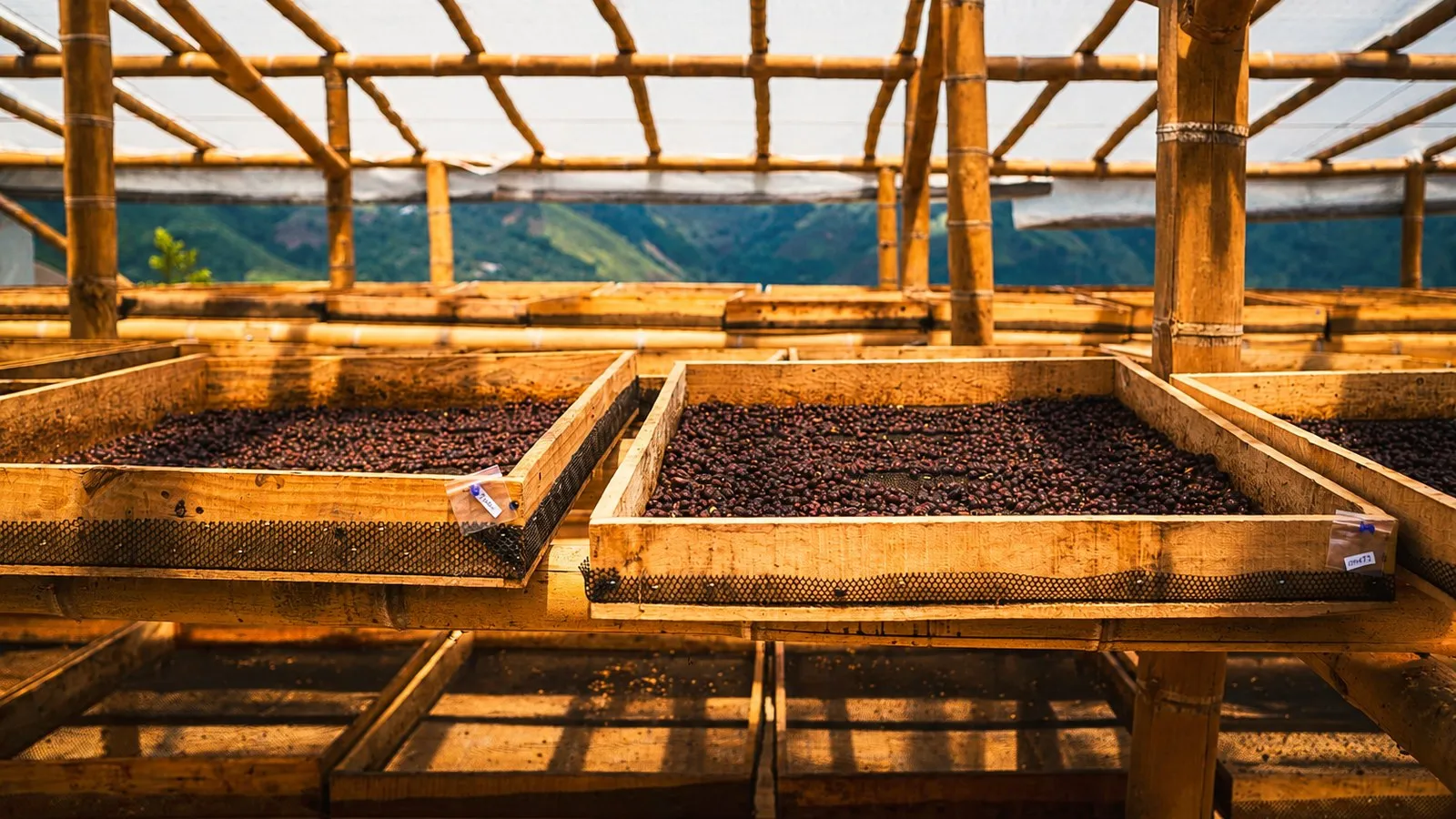
The strawberry you taste in a Gesha is not in the seed. It is not in the soil either, or the altitude, or the country printed in large type on the bag. Someone put it there, on a drying bed, days after the cherry was picked, betting the fruit would sweeten the bean before it spoiled it.
Take that bet apart and you have the whole story. One farm, one variety, one hillside in Huila, picked off the same trees in the same week. Split the harvest into three piles and change nothing but what you do next. One pile comes out clean and ringing — lime, bergamot, the bean showing through like light through tea. One comes out loud and jammy, all strawberry and blueberry and something close to red wine. The third sits between them, syrupy and round, sweet as stewed apricot. Same dirt. Same genetics. Same sun. A stranger would swear they came from three different continents.
We talk about coffee the way we talk about wine: terroir, origin, the mystique of a place. Origin is real. It sets the ceiling. But the specific note you fall for, the one the menu credits to “the region,” is mostly the answer to one quiet question on the patio. How long do you leave the fruit and its sticky sugars on the bean while it dries?
Three answers to one question
A coffee cherry is a fruit. The bean is its seed, wrapped in pulp and a layer of sugary slime called mucilage. Everything downstream turns on when you strip that fruit away.
Washed strips it fast. Within hours of picking, the cherries are pulped and the mucilage is fermented loose and rinsed off in water, leaving clean parchment-covered seeds to dry bare. Nothing is left to seep in. What you taste is the bean itself — the variety, the soil, the elevation, naked. That is why washed coffees read as transparent: high, ringing acidity, florals, citrus, the tannic pull of black tea, a finish you can see the bottom of. It is the honest cup. It hides nothing, which is also why a mediocre washed coffee tastes like exactly that, with nowhere to dress itself up. Competition roasters reach for washed lots when they want to prove a coffee is genuinely good and not merely loud.
Natural is the opposite instinct. You don’t strip the fruit at all. You lay the whole cherry out and dry it slowly, sometimes for two or three weeks, fruit and all, so the bean cures inside its own fermenting pulp. The sugars and the gentle ferment push inward. Out comes the loud cup: jam, overripe berry, a boozy edge that tips toward rum, a body that coats. The strawberry your friend swears is “just how Ethiopian coffee tastes” is, more honestly, what happens when an Ethiopian coffee is dried as a natural. Process the same beans washed and the strawberry mostly walks out the door.
Honey splits the difference, and the name has nothing to do with flavor. You pulp the cherry but leave some or all of the mucilage clinging to the bean as it dries — that sticky coat is the namesake. Leave a little and dry it quick and you get a yellow honey, close to washed but sweeter. Leave most of it on and dry it slow and dark and you get a red or black honey leaning toward natural. The result is the diplomat of the three: the clarity of a washed with the round sweetness of a natural, the rough edges of both sanded off. A honey is a producer turning a dial by hand.
Why the good ones are rare
Here is the part that should change how you read a bag. Washed is the safe craft. Water and fermentation tanks hand the producer control, and most mistakes are catchable before they cost the lot. Natural and honey are a high-wire act, because that fruit left on the bean is sugar sitting in the sun, and sugar in the sun wants to rot. Dry it too fast and the cup goes flat and papery. Too slow, piled too thick, one warm humid night without raking the bed, and the ferment tips from fragrant to faulty: vinegar, nail polish, the wet-cardboard fault tasters call phenolic, the sour funk of something that simply went off. The line between a transcendent natural and a ruined one is hours of attention spread across days.
That risk is the whole reason a flawless natural or a clean black honey is scarce, and scarcity is what walks them up the price ladder at auction. You are not paying for a fruit additive. Anyone can leave fruit on a bean. You are paying for the producer who walked the patio at two in the morning, raked the beds by hand, pulled the cherry under cover when the air turned, and threaded a needle most harvests miss. On the cupping scale, the three or four points between an 86 and an 89 are very often a single processing decision executed without one misstep across a thousand kilos of cherry. Most of the cheap, aggressively “funky” naturals on the market are badly managed ferments wearing the trend as a disguise.
So stop asking which process is best. It is the wrong question, like asking whether a photograph is better in color or in black and white. There is only what the producer was reaching for, and whether they pulled it off. Washed says here is the bean, naked, judge it. Natural says here is what I can build on top of it. Honey says here is the middle path, and the nerve to walk it. A great washed and a great natural are not competing. They are different sentences.
One practical thing, then, and it costs you nothing. Next time you buy coffee, find the processing word before you read the country. Washed, natural, honey — that one word predicts the cup in your hand more reliably than the flag on the label ever will, and once you read it first you stop being surprised by your own coffee. The country tells you where the music was recorded. The process tells you what song they chose to play.
The cherry never decided how it would taste. Someone on a drying bed did, and got it right against the odds. The least we can do is tell you which call it was.